When launching a website, one of the first decisions you’ll make is choosing the right type of web hosting. Two of the most popular options are Shared Hosting and VPS (Virtual Private Server) Hosting.
While both can host your website, they differ significantly in terms of performance, security, scalability, and cost. Choosing the wrong option can lead to slow loading speeds, poor user experience, or unnecessary expenses.
In this guide, we’ll compare Shared Hosting and VPS Hosting to help you decide which is the best fit for your website.
What Is Shared Hosting?
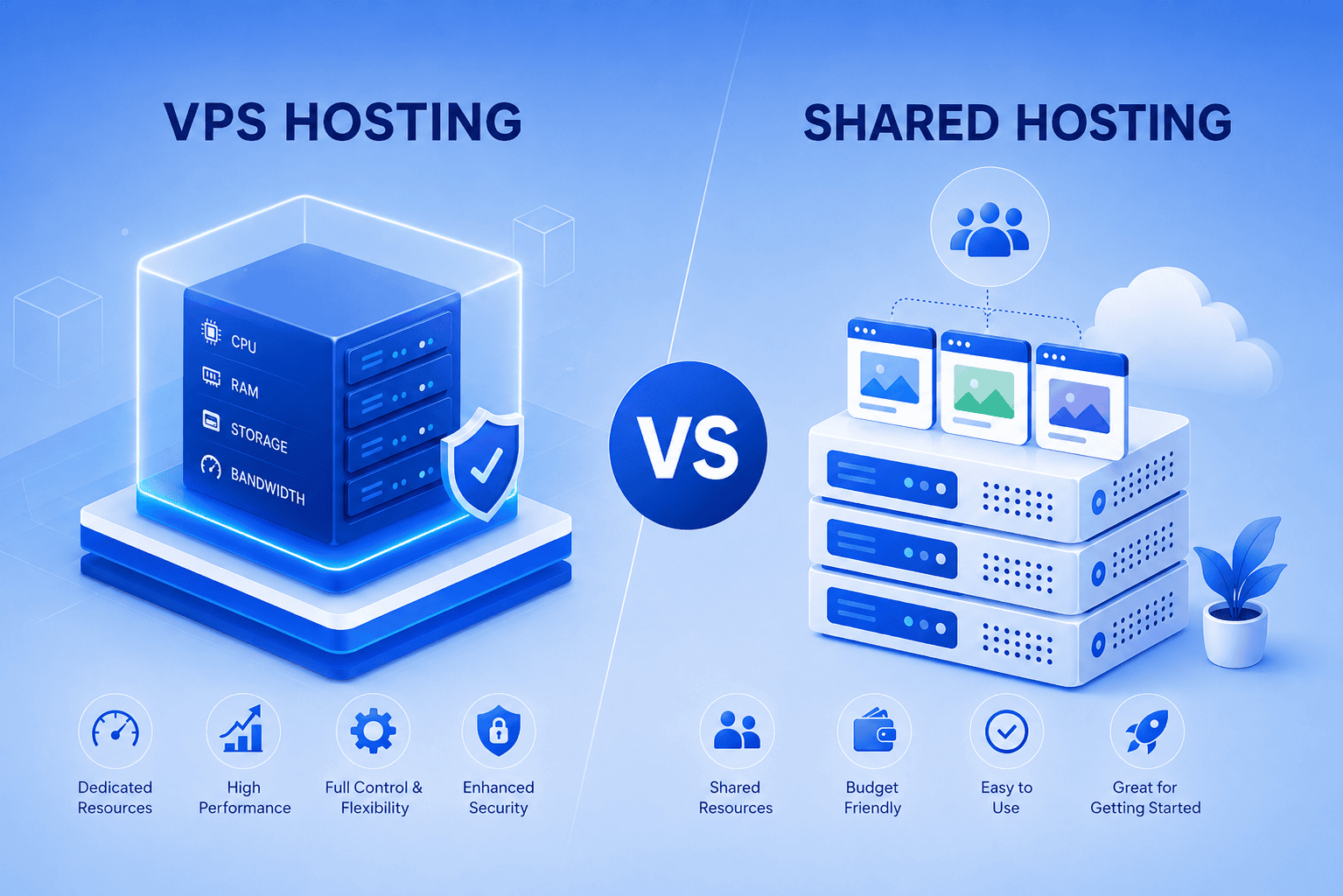
Shared hosting is a type of web hosting where multiple websites share the same physical server and its resources, including CPU, RAM, and storage.
Think of it like living in an apartment building—you have your own apartment, but you share the building’s facilities with other residents.
Because resources are shared, this is usually the most affordable hosting option.
Best For
- Personal websites
- New blogs
- Small business websites
- Portfolio websites
- Startup websites
- Low-traffic online stores
What Is VPS Hosting?
VPS stands for Virtual Private Server.
With VPS hosting, a physical server is divided into several virtual servers. Each virtual server has its own dedicated portion of CPU, RAM, and storage.
It’s similar to owning a townhouse—you have your own dedicated space and resources, even though you’re still part of a larger property.
This results in better performance and greater control than shared hosting.
Best For
- Growing businesses
- Medium-traffic websites
- WooCommerce stores
- Web developers
- Agencies
- Resource-intensive websites
Shared Hosting vs VPS Hosting: Key Differences
| Feature | Shared Hosting | VPS Hosting |
|---|---|---|
| Cost | Lower | Higher |
| Performance | Good for small websites | Better for growing websites |
| Server Resources | Shared | Dedicated allocation |
| Speed | Can vary depending on server load | More consistent |
| Security | Good, but shared environment | Better isolation and security |
| Scalability | Limited | Easy to upgrade |
| Technical Control | Basic | Greater control and customization |
| Best For | Beginners | Growing businesses |
1. Performance
Performance is one of the biggest differences between these hosting types.
With shared hosting, multiple websites compete for the same server resources. If another website experiences a traffic spike, your site’s performance may be affected.
VPS hosting provides dedicated resources, resulting in faster loading speeds and more consistent performance.
Winner: VPS Hosting
2. Pricing
Shared hosting is significantly more affordable.
Many providers offer shared hosting plans at prices suitable for beginners and hobby websites.
VPS hosting costs more because you receive dedicated resources and additional flexibility.
If you’re just starting, shared hosting usually offers the best value.
Winner: Shared Hosting
3. Website Speed
Website speed influences user experience, search engine rankings, and conversions.
Because VPS hosting provides dedicated resources, websites generally load faster, especially during periods of higher traffic.
Shared hosting can still perform well for smaller websites when paired with a reputable hosting provider.
Winner: VPS Hosting
4. Security
Both hosting types include security features, but VPS hosting offers better isolation.
If another website on a shared server encounters security issues, there is a greater chance of indirect impact than with a VPS.
Many VPS plans also allow more advanced security configurations.
Winner: VPS Hosting
5. Scalability
As your website grows, you’ll need additional resources.
Shared hosting has limitations, and upgrading may become necessary once your site receives more traffic.
VPS hosting is designed to scale more easily, allowing you to increase resources with minimal disruption.
Winner: VPS Hosting
6. Ease of Use
Shared hosting is designed for beginners.
Most plans include:
- One-click WordPress installation
- Easy-to-use control panels
- Automatic updates (depending on the provider)
- Simplified website management
VPS hosting may require more technical knowledge unless you choose a managed VPS plan.
Winner: Shared Hosting
7. Customization
Shared hosting limits what you can configure because you’re sharing the server with other users.
VPS hosting provides greater flexibility, allowing advanced users to customize server settings, install software, and configure environments to meet specific needs.
Winner: VPS Hosting
Pros and Cons
Shared Hosting
Pros
- Affordable
- Beginner-friendly
- Easy to set up
- Ideal for small websites
- Low maintenance
Cons
- Shared resources
- Limited scalability
- Performance may fluctuate during traffic spikes
- Less server control
VPS Hosting
Pros
- Faster performance
- Dedicated resources
- Better security
- More customization
- Easier to scale
Cons
- More expensive
- May require technical knowledge
- Overkill for very small websites
Which Hosting Type Should You Choose?
Choose Shared Hosting if you:
- Are launching your first website
- Have a limited budget
- Run a blog or personal website
- Own a small business website
- Expect low to moderate traffic
Choose VPS Hosting if you:
- Run a growing business
- Manage an eCommerce store
- Receive increasing traffic
- Need faster performance
- Require more server control
- Plan to host multiple websites
When Should You Upgrade from Shared Hosting?
It may be time to move to VPS hosting if:
- Your website is loading slowly.
- You’re receiving significantly more traffic.
- Your online store is growing.
- You need additional security.
- You’re reaching your hosting plan’s resource limits.
- You require custom server configurations.
Upgrading at the right time helps maintain a smooth experience for your visitors.
Final Verdict
Both Shared Hosting and VPS Hosting have their place.
For beginners, bloggers, freelancers, and small businesses, Shared Hosting is usually the best starting point. It’s affordable, simple to manage, and provides enough resources for most new websites.
As your website grows and demands more speed, security, and flexibility, VPS Hosting becomes the smarter long-term investment.
The best choice depends on your website’s size, traffic, budget, and future growth plans. Starting with shared hosting and upgrading to VPS when needed is a practical approach for many website owners.
Frequently Asked Questions
Is VPS faster than shared hosting?
Yes. VPS hosting typically offers faster and more consistent performance because you have dedicated server resources instead of sharing them with many other websites.
Is shared hosting enough for WordPress?
Yes. Shared hosting is suitable for most new WordPress blogs, portfolios, and small business websites. As your traffic grows, you can upgrade to VPS or another higher-tier hosting solution.
Can I upgrade from shared hosting to VPS later?
Yes. Most hosting providers allow you to upgrade from shared hosting to VPS hosting as your website grows, often with minimal downtime.
Is VPS worth the extra cost?
If your website receives high traffic, runs an online store, or needs better performance, security, and scalability, VPS hosting is often worth the additional investment.